
For our March feature in “Portraits of FoE Defenders,” human rights activist and lawyer Flutura Kusari speaks to CGFoE’s Senior Communications Manager Marija Šajkaš on justice for slain journalists, Europe’s anti-SLAPP movement, and the role courts play in protecting media freedom.
Flutura Kusari is an international human rights activist and lawyer specializing in freedom of expression and media freedom. She is a senior legal advisor for the European Centre for Press and Media Freedom (ECPMF), where she leads the legal support program for assisting media workers across Europe. She is the co-creator of Europe’s first anti-SLAPP movement, the Coalition Against SLAPPs in Europe (CASE). Flutura provides legal opinions on Anti-SLAPP laws and other media freedom legislation as a Council of Europe legal expert, helping European governments bring their legislation in line with the best European standards. She co-drafted the Council of Europe Recommendation on SLAPPs and contributed to the drafting of the EU Directive on SLAPPs as a member of the EU expert group. In 2024, Flutura received the Order of Merit of the Federal Republic of Germany in recognition of her outstanding contributions to media freedom, democracy, and civil society in Kosovo and Europe. She holds a Ph.D. from Ghent University in media freedom and a master’s degree from Queen Mary University of London.
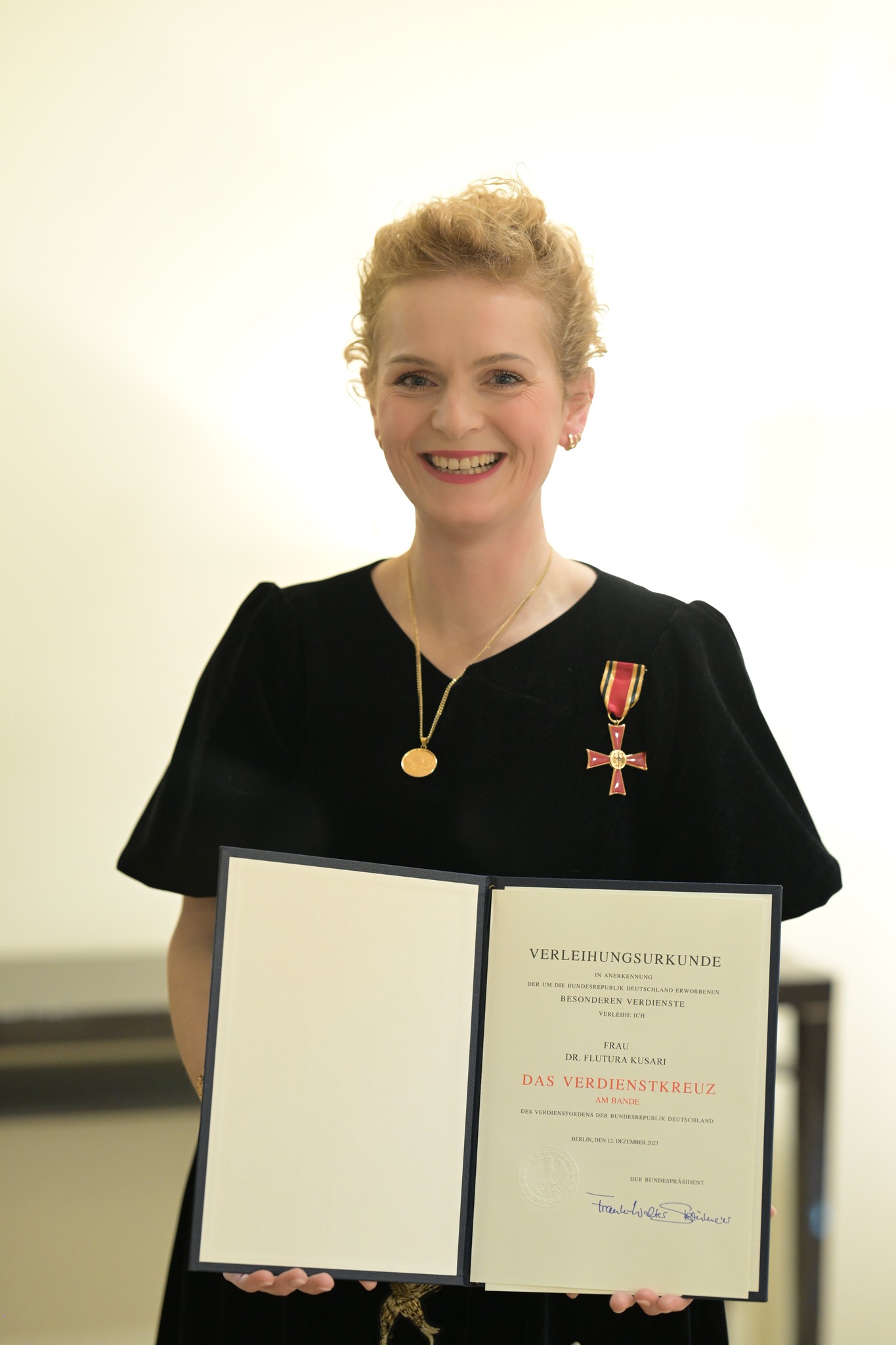
Flutura Kusari is an international human rights activist and lawyer, recognized with the Order of Merit of the Federal Republic of Germany for her outstanding contributions to media freedom, democracy, and civil society in Kosovo and Europe. Photo: courtesy of Flutura Kusari
Marija Šajkaš: You’ve been running ECPMF’s legal support program for journalists—one of the largest of its kind in Europe—for nearly a decade. We are from the same region, and for me, growing up, the concept of human rights was non-existent. How did you come into this field?
Flutura Kusari: Working on human rights is about fighting injustice and supporting people whose rights are being violated. Several factors shaped my path. In 1999, when I was 15, I experienced war in Kosovo together with my family. We became refugees, along with many others. Looking back, I know that journalists played an extremely important role in alerting the world to the killings and massacres that were happening in Kosovo at the hands of the Serbian state and army. That experience deeply influenced me. Later, I studied law and media and worked as an in-house media lawyer for an investigative outlet. About ten years ago, I moved to Leipzig to pursue my doctoral studies. Around the same time, ECPMF was established, and I became involved from day one. Today, we proudly run one of Europe’s largest legal support programs for journalists, assisting those who face defamation lawsuits, privacy claims, SLAPPs, and other forms of legal harassment.
The message is clear: kill the messenger so that criminal networks and corrupt actors can continue to operate
You closely monitor emblematic impunity cases, including the murders of Daphne Caruana Galizia in Malta and Ján Kuciak in Slovakia. Why is the progress so slow, and what does it take for the perpetrators to be brought to justice?
It has been an honor to support the family’s efforts to seek justice for Daphne Caruana Galizia and to monitor the case of Ján Kuciak and Martina Kušnírová. Unfortunately, these cases, along with the murder of Giorgos Karaivaz in Greece and others, demonstrate two troubling realities: first, states failed to protect them; and second, the fight for justice requires sustained and extensive campaigning. In some countries, families have been able to mobilize strong public advocacy efforts, but not all families have the resources or support to do so. None of these cases is fully resolved. What is particularly disturbing is that, in many instances, the individuals exposed by these journalists continue their business as usual.
The message is clear: kill the messenger so that criminal networks and corrupt actors can continue operating undisturbed, instead of being held accountable. That is why the work of international organizations in combating impunity is so important. Advocacy must be persistent and conducted in close collaboration with victims’ families to ensure that justice remains on the agenda.
What patterns have you observed in the threats journalists face, from the legal perspective? Also, has anything changed now that AI has been introduced?
Threats against journalists are evolving rapidly, but European institutions and governments are often lagging behind in developing effective protection mechanisms. In some cases, members of governments themselves contribute to the problem by verbally attacking journalists and fuelling anti-media narratives.
Online harassment is a major threat, particularly for women journalists. The attacks frequently focus not on their work, but on their appearance, personal data, or sexualized disinformation. This kind of objectification is intended to delegitimize them and discourage them from participating in public debate.
Artificial intelligence presents new and alarming challenges. It has become shockingly easy to create defamatory videos, deepfakes, and manipulated images targeting journalists. Yet there is still insufficient accountability for those who produce or distribute such content. It is urgent to work with platforms to ensure transparency when content is AI-generated and to hold them responsible when they allow harassment and abuse to spread.
Media content was disappearing due to legal threats
Another growing threat is the use of SLAPPs, strategic lawsuits against public participation. These cases are often designed to waste journalists’ time, energy, and financial resources so that they are unable to continue their investigative work.
You are a co-creator of Europe’s first coordinated anti-SLAPP movement. What have you achieved so far, and what is next?
Coalition Against SLAPPs in Europe emerged after Daphne Caruana Galizia was assassinated. As international organizations, we were not aware that media content was disappearing due to legal threats. Journalists refused to write about certain individuals because they knew they would be sued and had very limited resources to fight back. So we advocated, with the great support of Daphne’s sister Corinne Vella and her son Matthew Caruana Galizia, to convince European institutions to put in place European laws and standards to counter SLAPPs.
We now have a European Union Directive and a Council of Europe Recommendation, and it is up to member states to transpose this legislation at the national level. Once this is done, SLAPP cases will be dismissed very quickly by judges, and journalists and activists will no longer spend years proving that they were right and that the lawsuit is abusive.
Have any states provided promising examples in their transposition of the Anti-SLAPP Directive into national law?
As countries are working towards transposition, from what I know, Ukraine has undertaken the most comprehensive transposition of European standards and could be followed as an example. At the same time, Kosovo became the first country in Europe where the strategy of the Kosovo Judicial Council (the body governing courts) gives priority to SLAPP cases, meaning judges are required to prioritize them—again, another example to follow. Other countries, such as Poland and Estonia, are also working towards transposition.
I consider this one of the biggest achievements in media freedom in Europe in the last half-decade. It is tragic to think that it took Daphne’s life to address SLAPPs, and I will forever be grateful to her family for allowing us to use her name to achieve something that will help ensure that other journalists do not experience the same.
The more familiar judges are with the ECtHR standards, the better the judgments
In your experience training judges and legal professionals, where do courts most often struggle when applying freedom of expression standards in practice?
In the last decade, I have been engaged in training judges in South-East Europe and other European countries through the Council of Europe, an organization that invests heavily in promoting its standards and the case law of the European Court of Human Rights (ECtHR). What I have noticed is that the more familiar judges become with the standards of the ECtHR, the better the judgments we see, particularly in countries where democracy and the rule of law are respected. In certain contexts, applying these standards is also a matter of mindset. Judges may have a particular legal education or deeply rooted convictions, and sometimes a shift in mindset is necessary.
Courts play an extremely important role in protecting media freedom and journalists, especially when they are targeted by governments. That is why we need judges who are fully familiar with the highest standards. At the same time, we are seeing judges being attacked because of their rulings, particularly in politically sensitive cases.
In your work as a human rights defender, you are sometimes smeared and attacked—yet you persist. Where do you find the strength?
I follow three rules. Never engage with those who smear or attack you. They want to draw you into such confrontations, but I stay focused on topics that I consider matters of public interest. I also appreciate the support I receive. I have received support from organizations around the globe, including Columbia Global Freedom of Expression, which has given me strength and motivation. Finally, I prepare well, get the facts right, speak up, and never give up.
Authors

Marija Šajkaš
Senior Communications Manager