
In this week’s Jurisprudence in Focus, CGFoE Senior Communications Manager Marija Šajkaš interviews Pakistani journalist and activist Javeria Siddique about her tenacious fight for justice—in two courts, in two countries—for her late husband, a prominent Pakistani journalist, and the backlash she has faced for speaking out.
Javeria Siddique is a Pakistani journalist, columnist, author, and photographer. She is also widely known as one of the two widows of the slain Pakistani journalist Arshad Sharif and has been actively pursuing justice for her husband’s death through legal action and public advocacy. Sharif fled Pakistan for Dubai after facing sedition charges and death threats linked to an interview critical of the military; he was later forced to leave Dubai, moved to Kenya, and was fatally shot there under controversial circumstances in October 2022. Those responsible for his murder are still walking free.
This interview was conducted via written correspondence and has been edited for clarity and consistency.
Update: As we prepared this publication, Pakistan’s Federal Constitutional Court disposed of the case concerning Sharif’s killing—without a thorough investigation—on February 3, 2026. The Court held that, in light of the Kenya-Pakistan law-enforcement cooperation on the matter, there was “no need for any judicial interference.” “I am in extreme grief and disappointed,” Javeria Siddique told CGFoE in a comment.
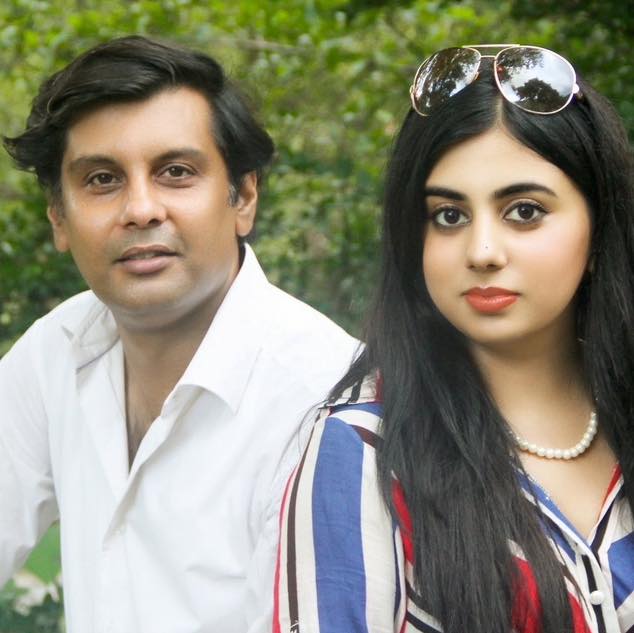
Journalist Javeria Siddique and her late husband Arshad Sharif, a prominent Pakistani journalist, fatally shot while in exile in Kenya. Siddique has been fighting for justice in his case in the courts of both Pakistan and Kenya. Photo: courtesy of Javeria Siddique
Marija Šajkaš: You are a journalist, but since 2022, much of your work has focused on seeking justice for your husband, Arshad Sharif. How do you remember him—as a journalist and as a person?
Javeria Siddique: I am trying to concentrate on my work, but my main focus remains on his cases in Kenya and Pakistan. I remember the late Arshad Sharif every day. We loved each other and were married for 12 years. I miss his smile, his photography. He gifted me hundreds of portraits he had taken of me. He was so kind. I miss his love. His library is still here with thousands of books—only he is missing. The house is empty without him. Arshad was very educated, so his killing marked an intellectual loss for the journalist community in Pakistan. He completed his Master’s from Ulster University with distinction. He was one of the finest investigative journalists, a war correspondent, and a popular TV host in Pakistan.
Where do the legal proceedings currently stand in both Kenya and Pakistan? Could you please give us an update? The Media Defence, which is helping with the case in Kenya, described the ruling as “encouraging” and called on authorities to fully implement the judgment. They also urge Pakistan to pursue the Supreme Court case on threats against Mr. Sharif and investigate alleged state involvement in his death.
It’s been four years since I started fighting the two cases in two countries, but so far, no one has been arrested for the murder. I’ve faced online and offline harassment because of the cases and my activism. The justice system is very slow, and governments aren’t willing to help us because Arshad was exposing corruption among the current ruling elite. In Pakistan, our case was buried in the Supreme Court, and now, after the 27th Constitutional Amendment transformed the judiciary, it’s landed in the Federal Constitutional Court (FCC), which has indicated it may conclude proceedings soon. It feels frustrating that they’re going to close our case without a proper investigation. He was threatened in Pakistan, charged in 16 fabricated cases, and his show was taken off the air. Why are those responsible for hatching his murder still free?
In Kenya, a court ruled the killing was murder, not an accident, and ordered a formal investigation. Now, this case is in front of the Supreme Court of Kenya, but the government is not cooperating and is unwilling to deliver justice for Arshad. In Pakistan, I have urged the FCC not to close the case, seeking international oversight and a comprehensive judicial commission. I would also like to ask the authorities in Kenya to please punish all those who were involved in this brutal murder.
In seeking accountability for his killing, you have had to engage with two very different legal systems. What were the most significant differences in how the cases were handled? How did those differences shape your pursuit of justice?
Inside the Court in Pakistan, I’ve been treated more like a suspect than a victim
The differences in handling the cases in Pakistan and Kenya have been stark. In Pakistan, I’ve faced significant restrictions, like not being allowed to take my phone inside the Supreme Court, undergoing body and bag searches, and having my identity card taken away, which made me anxious. I’ve been treated more like a suspect than a victim. I’ve been denied permission to speak multiple times, despite being the victim’s spouse. The court always gave more time to the government. In addition, I always felt that the state lawyers were representing the Kenyan government, as opposed to their own citizen, Arshad Sharif, who was killed on foreign soil.
In contrast, Kenya’s judiciary has been more accommodating. The judge even allowed me to speak, and I cried, feeling heard for the first time in years. I’ve attended meetings online, and the judge has listened to me during the one-year hearing. The Kenyan High Court ruled the killing was targeted murder, not due to mistaken identity, and the case is now in front of the Supreme Court. This difference in treatment has shaped my pursuit of justice—I’ve felt more supported in Kenya, while in Pakistan it’s been a struggle to maintain dignity and a voice.
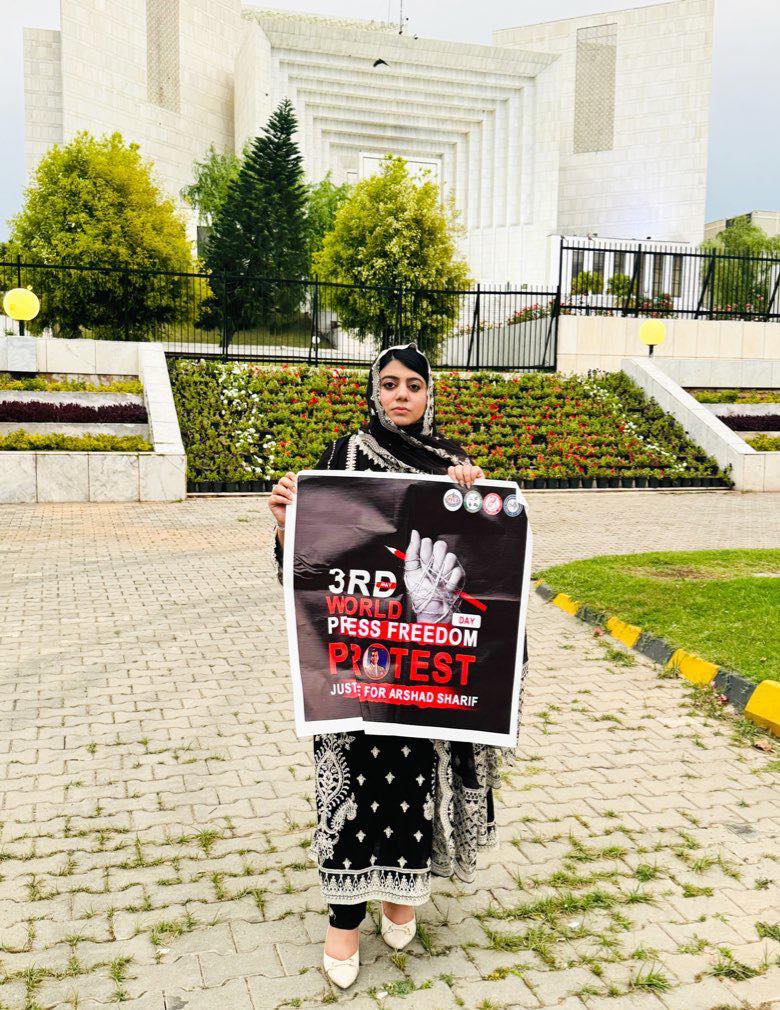
Photo: courtesy of Javeria Siddique
Before Arshad was killed, he and his colleagues were already facing pressure from the authorities. How would you describe the media environment in Pakistan today? In particular, how has the Prevention of Electronic Crimes (Amendment) Act 2025, portrayed by some as “Draconian Cyber Law,” affected journalists and activists?
Arshad was facing several problems in Pakistan in 2022. He was experiencing harassment and intimidation, both on the Internet and in real life, likely due to his critical reporting and commentary. He was charged in several fabricated cases for treason and sedition, with the likely aim of silencing him. His TV show was taken off the air, which was another indication of pressure from those in power. Finally, he received multiple threats to his life, including a warning from a ruling elite, which prompted him to flee the country, only to be killed in Kenya. Since that time, the media has been under complete censorship in Pakistan.
Today, journalists and activists are facing immense pressure from the Pakistani authorities, and the Prevention of Electronic Crimes (Amendment) Act 2025, or the PECA law, has made things worse. This law criminalizes “fake news” and gives the government broad powers to regulate online content, which critics say is a thinly veiled attempt to suppress dissent and critical journalism. Human rights organizations and journalist groups have condemned the law, saying it’s an attack on freedom of expression and will lead to self-censorship.
Since 2022, 14 journalists lost their lives
Some notable cases against individuals in Pakistan after 2022 include Imaan Zainab Mazari-Hazir and Hadi Ali Chatta, human rights lawyers sentenced to 17 years in prison and fined 36 million Pakistani rupees for social media posts criticizing the government. We have journalist Khalid Jamil, who was arrested by the National Cyber Crime Investigation Agency for sharing “highly intimidating content on social media,” as well as journalist Matiullah Jan, who was indicted in a fabricated case involving allegations of drug possession and terrorism.
Other journalists facing violence and charges include Imran Riaz Khan, Jameel Farooqi, Sami Ibrahim, Ahmed Noorani, Sabir Shakir, Wajahat Saeed, and Moeed Pirzada. In addition, journalists, including Farhan Mallick, Aslam Shah, Asad Ali Toor, Harmeet Singh, Nadir Abbas, Waheed Murad, Shakir Awan, Sohrab Barkat, Agha Sarwar, have been targeted under the PECA law. In all, eight leading anchors are now off air due to censorship, and 14 journalists lost their lives during this time frame.
Finally, female journalists in particular are facing online threats and harassment: Asma Shirazi, Munizae Jahangir, Freeha Idress, Samina Pasha, and Sadia Mazhar. I am also in that group.
Indeed. In a recent social media post, you described “relentless harassment and intimidation,” including unknown individuals repeatedly visiting your home, ringing the doorbell, and inquiring about your movements in your neighborhood. In the face of this continued pressure, where do you find the strength to continue?
After the tragic killing of my husband, I faced harassment in real life and online. In December 2025, unknown individuals visited my home twice, calling out my name and inquiring about me in the neighborhood. In January 2026, this harassment continued with someone shouting outside my house and another person asking about me. I’ve contacted the police, but they never filed my report. Arshad Sharif faced similar harassment before his murder. On top of that, a malicious online campaign alleged that I remarried during my edat (mourning period), a serious allegation in Pakistan’s cultural context. I filed a complaint, but no action was taken against those responsible. The allegations against me were baseless and aimed at character assassination. My case shows the challenges women face in Pakistan, especially when seeking justice. The government’s response has been inadequate, adding to distress. As a journalist, widow, and citizen, the state hasn’t given me anything—not even kind words. But like any taxpayer, I deserve to live with dignity.
To learn more, read CGFoE’s analysis of the 2024 ruling, in which the High Court of Kenya found the killing of Arshad Sharif unlawful and condemned the authorities’ failure to conduct a timely and independent investigation. Another case, the Pakistani Supreme Court’s 2018 decision concerning comments made by Sharif on air, points to censorship preceding his exile.
Authors

Marija Šajkaš
Senior Communications Manager