
On November 18, 2025, the Dominican Constitutional Court issued Judgment TC/1225/25, striking down Articles 210 and 260 of the disciplinary codes of the National Police and the Armed Forces, which criminalized consensual same-sex intimacy among police and military personnel with penalties of up to two years in prison.
WHAT MAKES THE DECISION HISTORIC?
- It is the first time the Court has explicitly recognized sexual orientation as a constitutionally protected category against discrimination.
The Court held that “no state authority nor private actor may diminish or restrict rights based on sexual orientation,” framing sexual orientation as an aspect of dignity, privacy, and the free development of personality
- It dismantles a regime of “State-sponsored homophobia.”
The impugned provisions were relics of the 1950s–1960s that singled out same-sex relations for criminalization while allowing identical heterosexual conduct. They enabled dismissal, imprisonment, and life-long stigma for LGBTI personnel, even for private conduct outside service. As the Human Rights Watch statement noted, the decision “ends a discriminatory and abusive law that has harmed countless LGBTI members of the security forces.”
- It represents the country’s first strategic constitutional litigation with general impact for LGBTI rights.
As acknowledged in the judgment and by Human Rights Watch, the ruling sets a binding and non-appealable precedent that protects sexual minorities in public service and strengthens constitutional equality in a country where anti-LGBTI discrimination is widely tolerated institutionally and socially.
- It realigns the Dominican Republic with regional and international human rights standards.
The decision resonates with the jurisprudence of the Inter-American Court (Atala Riffo, Flor Freire, Duque), the UN Human Rights Committee (Toonen), and comparative constitutional courts that reject criminalization or disciplinary sanctioning of LGBTI identities and private conduct.
- It has broader democratic significance.
The Court reaffirmed the supremacy of the Constitution and the limits of state power in contexts where religious actors, police, and military authorities exert enormous influence. It protects judicial independence and the rule of law in the face of political backlash, disinformation campaigns, and open declarations of non-compliance by high-ranking officials.
THE OUTCOME OF THE JUDGEMENT AND ITS RELEVANCE FOR FoE
In Section 5.6 of the Direct Action in Unconstitutionality—titled “The impugned norms constitute State homophobia and, as such, violate by irradiation the right of all LGBTI persons to participate in public service in full exercise of their freedom of expression”—the petitioners advanced a sophisticated argument linking the criminalization of same-sex intimacy to violations of freedom of expression. The key arguments were:
- Sexual orientation is an expressive identity element (ICCPR arts. 19 & 25; ACHR arts. 13 & 23(1)(c)).
The ability of LGBTI individuals to express who they are, including through consensual intimate relationships, is protected freedom of expression. Criminalizing same-sex intimacy punishes individuals for expressing their identity and for defying compulsory heterosexual norms.
- Criminalization suppresses political participation and access to public service.
The disciplinary codes deter LGBTI individuals from joining, remaining in, or advancing within police and military careers—public institutions central to democratic governance. This creates an exclusionary environment incompatible with ICCPR art. 25 and ACHR art. 23.
- Criminalization produces chilling effects on speech about sexual orientation.
Fear of dismissal, arrest, and stigma forces LGBTI officers to hide:
- their relationships,
- their views on equality,
- their community ties,
- their participation in human rights movements.
This chilling effect violates core international standards on how law and stigma silence marginalized groups and restrict access to public discourse.
- The provisions create a hostile environment amounting to “State-sponsored homophobia.”
By singling out sexual minorities for punishment, the state’s own disciplinary codes propagate discriminatory norms, reinforcing social hostility and silencing LGBTI individuals in public institutions.
The Constitutional Court did not directly address the petitioners’ freedom-of-expression claims. However, the judgment’s outcome still has powerful positive consequences for freedom of expression. By eliminating criminal penalties tied to sexual orientation, the ruling:
- removes structural barriers that forced LGBTI personnel to suppress their identity;
- enables safe participation in public institutions without fear of reprisal;
- contributes to dismantling social stigma that chills speech;
- expands the expressive space for LGBTI individuals across Dominican society;
- aligns the Dominican Republic with global jurisprudence, recognizing sexuality and gender identity expression as protected speech.
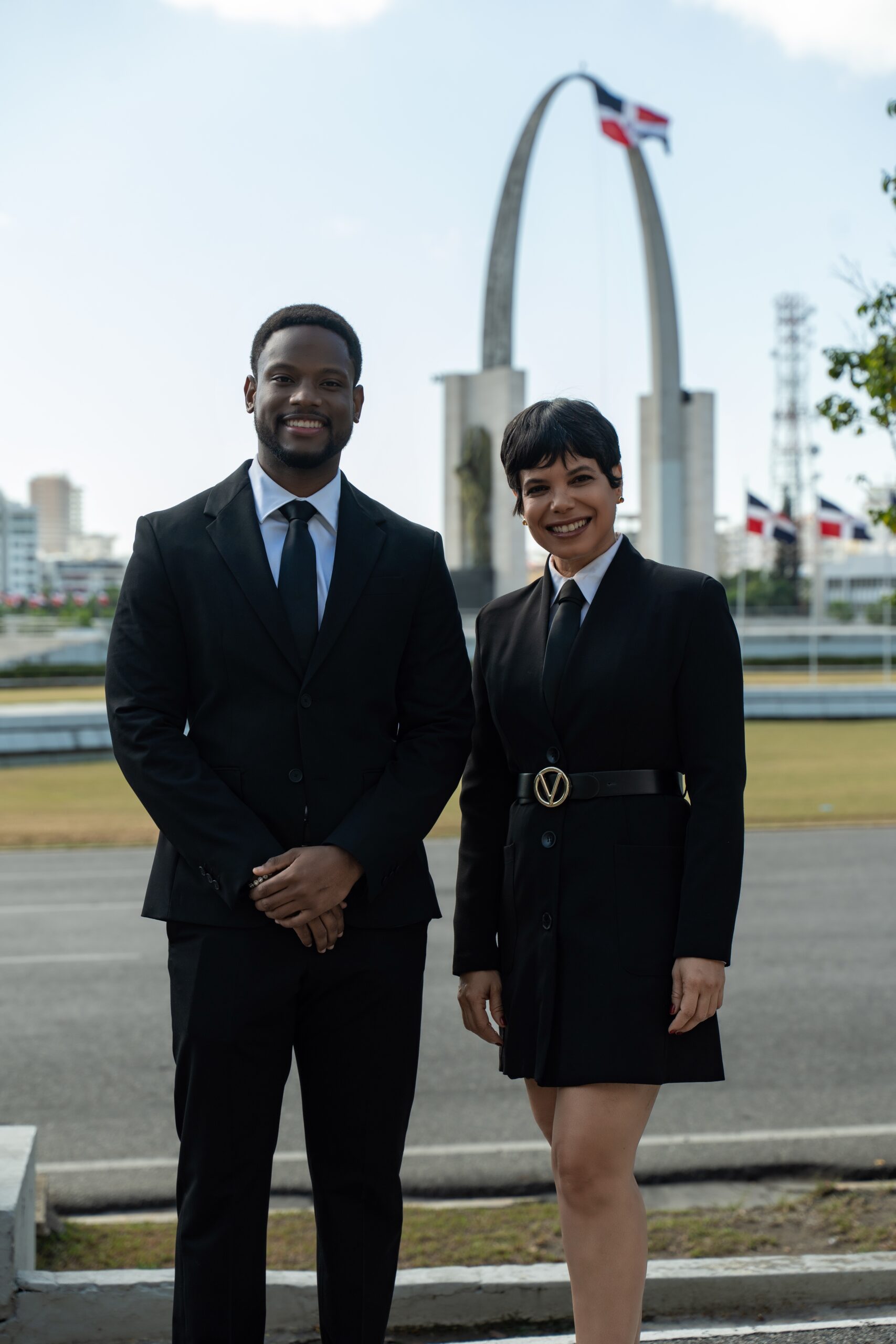
Anderson Javiel Dirocie De León and Patricia M. Santana Nina on the day of the hearing.
ABOUT PETITIONERS
Anderson Javiel Dirocie De León
Co-petitioner, human rights lawyer, legal scholar, and Senior Legal & Policy Consultant at Columbia Global Freedom of Expression (Columbia University).
- PhD Candidate in International Law at the Graduate Institute, Geneva
- LLM, Harvard Law School; Advanced Master in Public International Law, Leiden University
- Fellowships at the ICC, IACtHR, and CGFoE
- Member of the Legal Committee of the LGBTI+ Litigants Network of the Americas
- Extensive scholarship on equality, free expression, structural discrimination, and international human rights
His involvement in the case solidified the bridge between global academic/advocacy institutions and civil society efforts in the Dominican Republic. His human rights expertise—particularly on non-discrimination, dignity, and structural exclusion—was essential to framing the case as one of constitutional principle and comparative human rights.
Patricia M. Santana Nina
Co-petitioner, constitutional law specialist, human rights defender, and member of the Advisory Council of the Ibero-American Network of Women Mediators—aligned with the UN Women, Peace, and Security agenda.
- Specialized training from the University of Salamanca, University of Castilla-La Mancha, National School of the Judiciary (ENJ), Judicial School of Spain, FLACSO Argentina, and UNIBE
- LLB, Pontificia Universidad Católica Madre y Maestra (PUCMM)
- University professor of constitutional law, constitutional procedural law, and administrative law
- Member of CLADEM, CLACAI’s Legal Network, the Dominican Chapter of the Ibero-American Institute of Constitutional Law, and regional networks of women mediators and gender-rights defenders
- First woman to promote strategic human rights litigation in the Dominican Republic
Her expertise in constitutional law, administrative law, gender, and judicial governance provided the procedural rigor and doctrinal depth required for a successful constitutional challenge.
Authors

Anderson Javiel Dirocie De León
Senior Legal and Policy Consultant
PhD candidate in International Law, Geneva Graduate Institute of International and Development Studies

Patricia Santana
Dominican lawyer, feminist activist, human rights defender, university professor, specialist in constitutional law, administrative law, and judicial law, with studies in gender issues.