
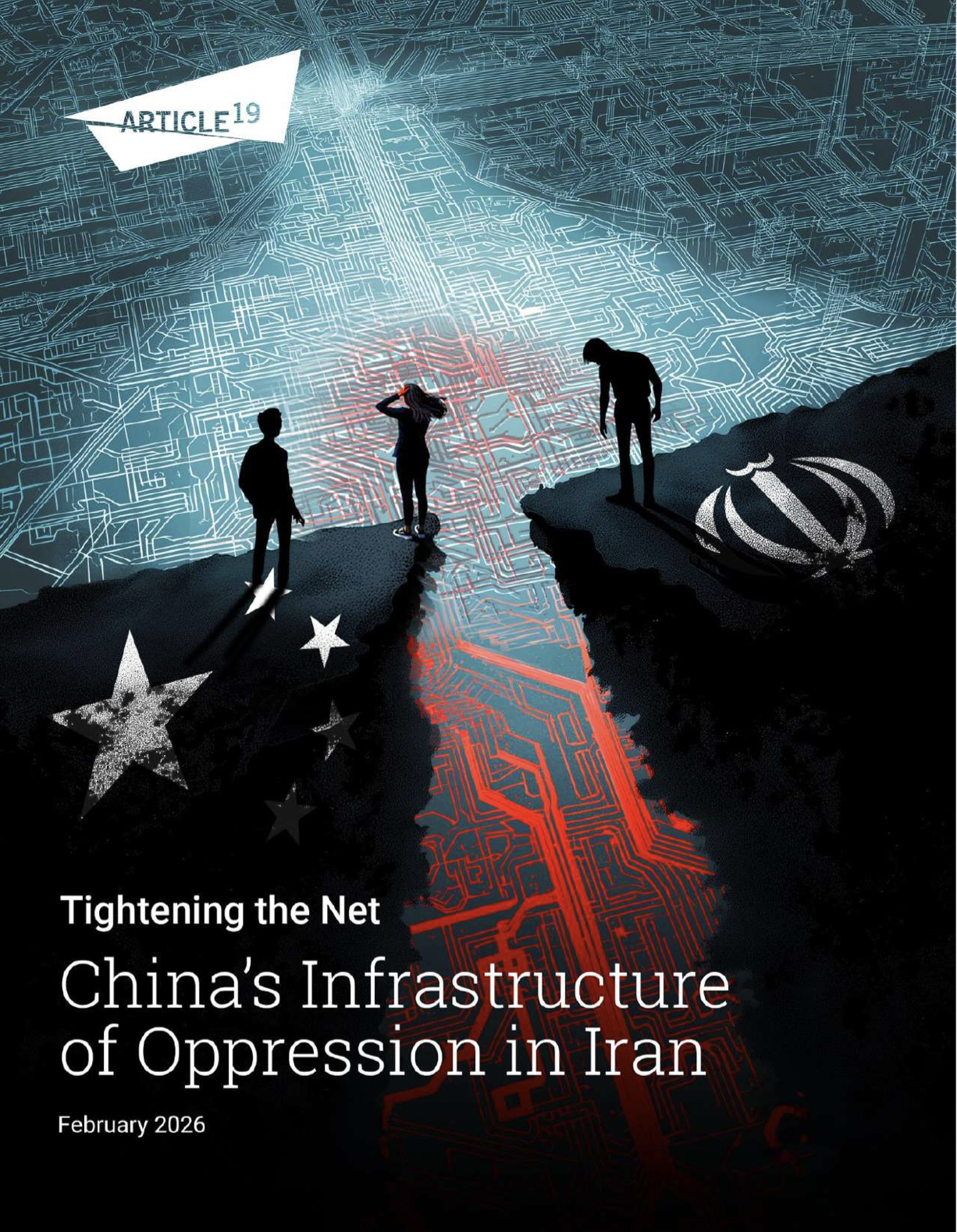
ARTICLE 19 published a new report, Tightening the Net: China’s Infrastructure of Oppression in Iran, analyzing the digital cooperation between China and Iran—a partnership that has played a leading role in Iran’s expansion of digital repression.
In the aftermath of Iran’s brutal crackdown on protests, experts suggest the deployment of Russian and Chinese technology helped the regime execute a near-total internet blackout. ARTICLE 19’s new report digs deeper: China’s support since at least 2010 has facilitated “the creation of the infrastructure of oppression in Iran.” ARTICLE 19 underscores the role of China’s “cyber sovereignty” doctrine and shows that, notwithstanding international sanctions, Chinese companies ZTE, Huawei, Tiandy, and Hikvisi have been supplying surveillance technologies to Iran, aiding the regime in the perpetration of gross human rights violations.
Executive Summary (excerpt)
“China has emerged as Tehran’s major ally and trading partner, including through technology transfer and normative exchange under the Belt and Road Initiative, and its tech-focused Digital Silk Road (DSR). This alliance extends beyond infrastructure, embodying mutual normative embrace of ‘cyber sovereignty’—the notion that states have absolute control over their internet governance ecosystem—challenging human rights law and internet freedom principles.
China’s material and technical support since at least 2010 has been instrumental in the creation of the infrastructure of oppression in Iran, supercharging surveillance and censorship capabilities, including for internet shutdowns. Chinese companies such as ZTE, Huawei, Tiandy, and Hikvision have provided core surveillance and internet-filtering technologies.
Despite international sanctions and legal penalties, Chinese firms have sought means of continuing operations in Iran, often through front companies, complicating accountability. The involvement of Chinese vendors in supplying censorship and surveillance technologies to Iran has contributed to the government’s ability to perpetrate human rights abuses, often disproportionately against ethnic and religious minorities and women.
At the institutional level, Iran’s Supreme Council of Cyberspace mirrors the Cyberspace Administration of China. Both operate under highly centralised leadership—Supreme Leader Ali Khamenei and Xi Jinping respectively—and enforce repressive internet control. At the normative level, Iran’s National Information Network closely aligns with the Great Firewall of China. Under their embrace of cyber sovereignty, both regimes centralise censorship, surveillance, and information manipulation, promoting state and Party-approved digital ecosystems while suppressing free expression and access to information.
The partnership between China and Iran, part of wider networked authoritarianism that includes Russia and North Korea, poses a serious threat to global internet freedom and international human rights, especially the freedom of expression and information.”