
Human rights lawyers Anderson J. Dirocie De León and Patricia M. Santana Nina, the petitioners behind a landmark decision advancing equality in the Dominican Republic, speak to CGFoE about their legal challenge, the backlash against it, and the renewed hope in the struggle for LGBTI rights.
In November 2025, a legal challenge led by CGFoE’s Senior Legal & Policy Consultant Anderson J. Dirocie De León and constitutional law specialist Patricia M. Santana Nina resulted in a historic ruling by the Constitutional Court of the Dominican Republic. The Court struck down provisions that criminalized consensual same-sex intimacy among police and military personnel, recognizing sexual orientation as a protected constitutional category. To learn more about the judgment, see this backgrounder.
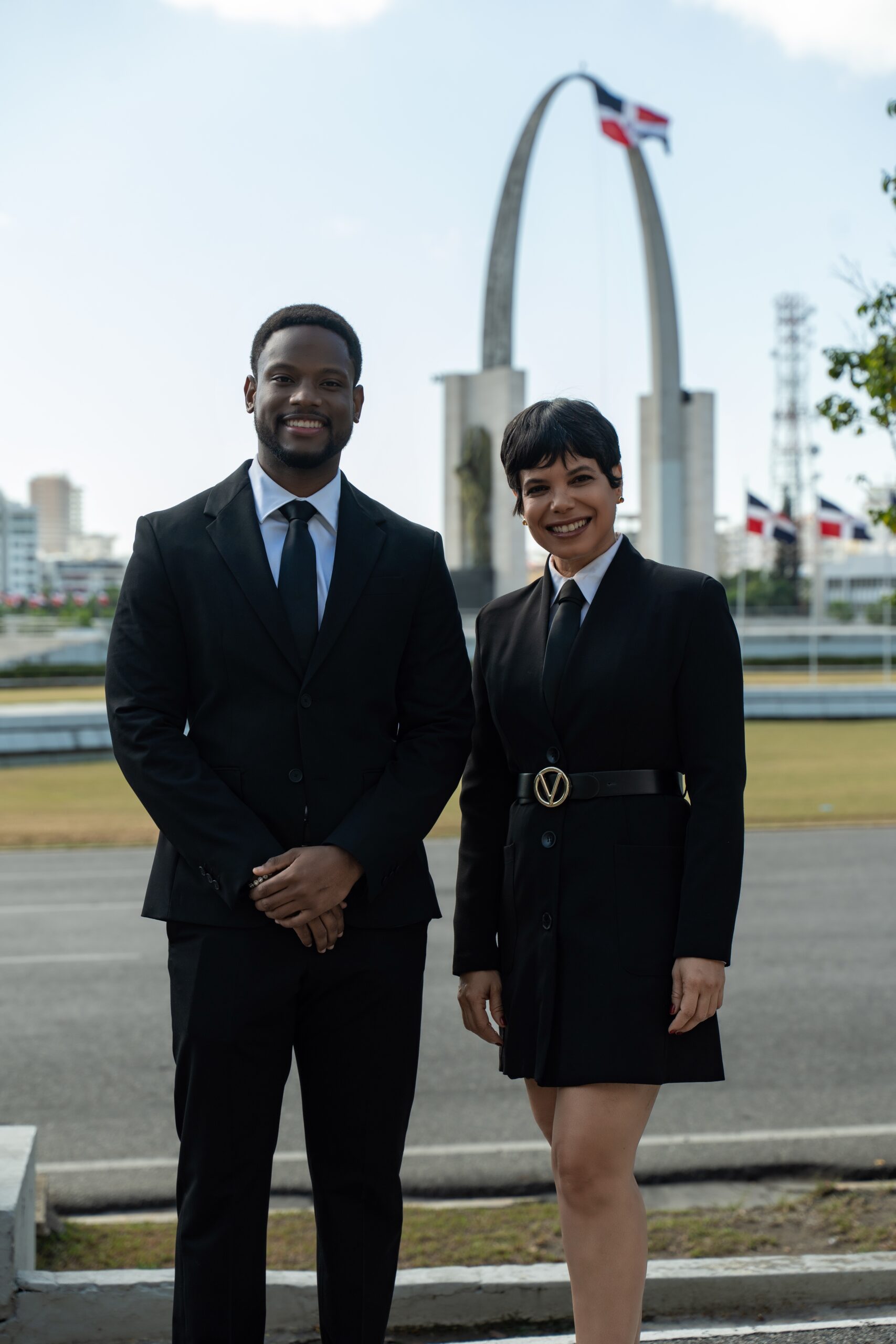
Anderson J. Dirocie De León is an international & human rights lawyer, legal scholar, and Senior Legal & Policy Consultant at CGFoE. Patricia M. Santana Nina is a constitutional law specialist, human rights defender, and member of the Advisory Council of the Ibero-American Network of Women Mediators. Photo: Dirocie De León and Santana Nina on the day of the hearing.
As part of our new Jurisprudence in Focus series—conversations with legal professionals on significant court decisions—we asked Dirocie De León and Santana Nina to reflect on the path to the ruling and what the precedent means for the country, its institutions, and the ongoing fight for equality. The interview was conducted in writing, with Dirocie De León and Santana Nina choosing to answer select questions jointly.
CGFoE: Anderson and Patricia, this ruling has been described as a historic advance for equality and human rights in the Dominican Republic. What compelled you to start on this journey?
Anderson & Patricia: We have both dedicated our professional careers to the defense of the rights of historically marginalized groups. In the Dominican Republic, it was widely known and even publicly acknowledged by the then-Director of the National Police that these institutions excluded openly LGBTI persons. However, the legal basis for that exclusion was unclear.
Patricia, along with lawyers Ivanna Molina and Alexandra Sued, identified the unconstitutional laws and discovered that these discriminatory provisions were still formally in force. At the same time, Patricia was contacted about a potential case involving a member of the armed forces who had been detained solely because her superiors learned of her sexual orientation after she shared that information with colleagues.
These rules affected not only equality, but also the right to work, personal dignity, privacy, and the life projects of LGBTI service members. Because these provisions criminalized homosexuality with penalties of up to two years in prison, it became clear that they had to be challenged before the country’s highest constitutional tribunal.
What were some of the main hurdles you faced, and did you come across any unexpected allies along the way?
The main hurdle we faced was the broader social context of prejudice, rejection, and misinformation surrounding LGBTI persons in the Dominican Republic. For certain sectors of society, exclusion and discrimination based on sexual orientation are still perceived as legitimate or socially acceptable. This is often rooted in deeply entrenched stereotypes that portray LGBTI persons as inherently unfit to perform public functions, particularly within law enforcement or the army. These views are reinforced by religious narratives that frame same-sex relationships or conduct as sinful.
The mere existence of challenged provisions lent institutional legitimacy to an openly homophobic vision endorsed by the State. In this context, even with strong legal arguments on our side, there was a real concern that deeply ingrained prejudices could influence the judicial sphere and result in an unfavorable decision.
Fortunately, we also encountered significant and, in many cases, unexpected support. At the domestic level, Diversidad Dominicana, the law firm AEQUUS, and the Dominican chapter of the Latin-American Council for International and Comparative Law Scholars (COLADIC-RD) submitted amicus curiae briefs supporting the declaration of unconstitutionality. At the regional and international levels, organizations such as Human Rights Watch, the LGBTI+ Litigants Network of the Americas, Colombia Diversa, the Federación Argentina de Lesbianas, Gays, Bisexuales y Trans (FALGBT+), and Optio.org, also filed briefs in support of the case.
Backlash is often a sign that a structural barrier is being challenged
Patricia, before this challenge, you have successfully used constitutional litigation to dismantle structural discrimination in electoral law, which led to increasing the representation of women in the National Congress. How did that earlier case inform your approach to this one?
That earlier constitutional challenge was foundational to how I approached this one. I learned that strategic constitutional litigation is not only about correcting a legal defect, but about exposing a structural inequality that the legal system has normalized. The success of that first case showed me the importance of framing discrimination as a systemic pattern sustained by law, institutional practices, and cultural assumptions. It gave me both a methodological roadmap and the confidence to seek transformative, not merely corrective, outcomes.
That experience shaped my approach in three main ways. First, it reinforced the need to ground the litigation in constitutional principles of equality, dignity, and substantive non-discrimination. Second, it taught me the value of combining legal arguments with contextual evidence, showing how a seemingly neutral rule produces disproportionate and harmful effects on a specific group. And third, it underscored the importance of thinking beyond the courtroom: anticipating resistance, engaging public debate, and understanding that backlash is often a sign that a structural barrier is being challenged.
In this challenge, as in the earlier case, the law was being used to legitimize exclusion based on identity, and constitutional litigation became a tool to question not only legality but the social order that the law was protecting.
This is a landmark decision grounded in principle, one that offers renewed hope
Anderson, do you see this decision as opening paths to further challenges against discriminatory norms affecting LGBTIQ+ people in the Dominican law?
We must be conscious that this is the first time the Court has explicitly recognized sexual orientation as a constitutionally protected category against discrimination. Until now, not even the Criminal Code, in its provision on the crime of discrimination, explicitly included sexual orientation as a prohibited ground.
The Court held that no state authority or private actor may diminish or restrict rights on the basis of sexual orientation, framing it as an inherent aspect of human dignity, privacy, and the free development of personality. This is, without question, a landmark decision grounded in principle, one that offers renewed hope in the struggle for equality and the full recognition of the rights of LGBTI persons.
My hope is that all courts will fully respect the binding nature of this ruling and that it will serve as a foundation for resolving other pending issues that continue to undermine the equal enjoyment of rights by this community.
Following the ruling, what kinds of reactions did the two of you encounter?
On the one hand, we encountered strong support from human rights organizations, LGBTIQ+ activists, legal scholars, and individuals within the legal community who recognized the decision as a historical milestone and a long-overdue affirmation of constitutional equality and human dignity. For many, the ruling represented a symbolic break with decades of institutionalized discrimination.
On the other hand, we faced a coordinated backlash from conservative and religious sectors, as well as from some actors within the police and the military. This included public narratives framing the decision as a threat to discipline, morality, or national security, and, more concerningly, statements by senior officials suggesting they would continue applying internal disciplinary codes despite the ruling.
We also observed attempts to reduce the scope of the judgment to a “moral debate” rather than a constitutional matter and instill fear among judges and public servants about the consequences of enforcing the decision, confirming that criminalization was not merely a legal rule, but a mechanism for maintaining exclusion through stigma and institutional power.
Overall, the post-ruling landscape made clear that constitutional litigation cannot, on its own, dismantle the social and institutional resistance that sustains them—the reasons why we need to focus on implementation, public education, and the defense of judicial independence as integral parts of strategic litigation.
Sexual orientation is an expressive aspect of personal identity
Finally, how does this decision expand expression in the Dominican Republic?
Although the Court did not explicitly rely on freedom of expression, the decision significantly expands expressive freedom in the Dominican Republic. Sexual orientation is an expressive aspect of personal identity, and the criminalization of same-sex intimacy forced LGBTI individuals to conceal who they are.
By eliminating these provisions, the ruling removes legal barriers that produced fear, self-censorship, and exclusion from public service. It also reduces the broader chilling effect on speech about equality, community, and human rights advocacy. In that sense, even through an equality-based approach, the judgment strengthens freedom of expression by dismantling structural discrimination that had long silenced LGBTI voices.
Authors

Anderson Javiel Dirocie De León
Senior Legal and Policy Consultant
PhD candidate in International Law, Geneva Graduate Institute of International and Development Studies

Patricia Santana
Dominican lawyer, feminist activist, human rights defender, university professor, specialist in constitutional law, administrative law, and judicial law, with studies in gender issues.